
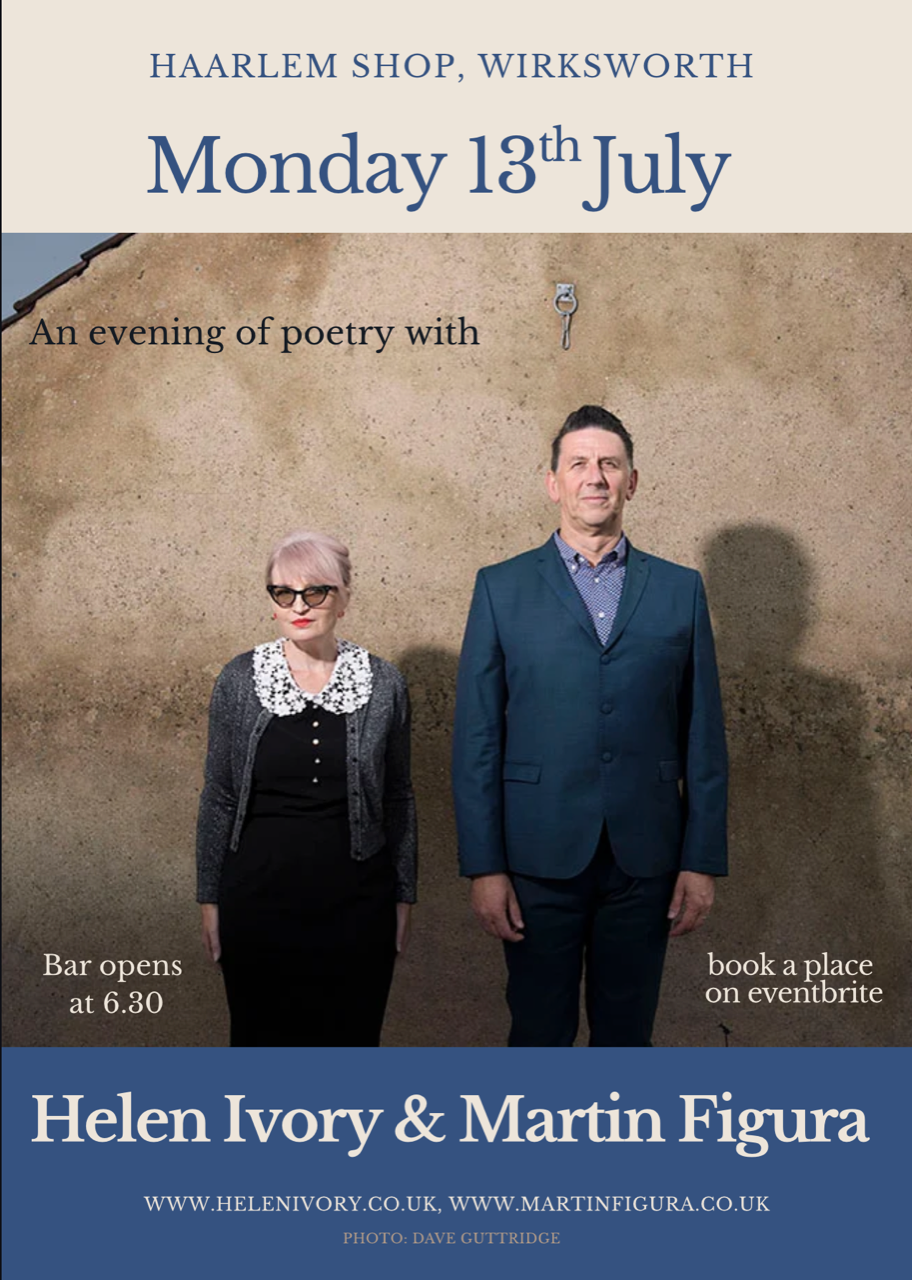
Martin Figura´s collection and show Whistle were shortlisted for the Ted Hughes Award and won the 2013 Saboteur Award for Best Spoken Word Show. Shed (Gatehouse Press) and Dr Zeeman´s Catastrophe Machine (Cinnamon Press) were both published in 2016. In 2021, he was Salisbury NHS Writer in Residence; the resulting pamphlet My Name is Mercy (Fair Acre Press) won a national NHS award. A second pamphlet from Fair Acre Press Sixteen Sonnets for Care came out in October 2022. His latest collection, The Remaining Men was published by Cinnamon Press in 2024. He’s been touring his theatre show Shed this year. A translated selected collection of his work Coal is being published in Greek for the Thessaloniki Poetry Festival this year. Mortality, I Could Live Without It is due out with Nasty Little Press in November
Helen Ivory is a poet and visual artist who makes shadowboxes and collage. She was awarded a Cholmondeley Award by the Society of Authors in 2024. She edits the webzine Ink Sweat and Tears and teaches for the National Centre for Writing Academy. Her surrealist chapbook Maps of the Abandoned City was published by SurVision
in 2019 and the poem The Square of the Clockmaker is riding the rails as one of the Poems on the Underground. She has work translated into Polish, Ukrainian, Croatian, Spanish and Greek as part of the Versopolis European poetry platform. Her Wunderkammer: New and Selected Poems appeared from MadHat in the US last year. Constructing a Witch (October 2024) , her sixth collection with Bloodaxe Books, is a PBS Winter Recommendation.
Photo credit – Dave Guttridge
“Martin Figura’s poems are humane, clear-eyed, and compassionate without the least sentimentality. He has written directly out of people’s lives, particularly in hospitals, in the army and in the workplace. He is the laureate of the ordinary and overlooked. For all those reasons The Remaining Men is a very powerful collection that deserves to be read widely.”
George Szirtes
“Helen Ivory’s Constructing a Witch is a blazingly angry book, but the word that came to me on a first reading was ‘playful’. This does not mean by any means that it is a frivolous or light-hearted one – the pace and tone keep the book from feeling like a manifesto or a rant but take nothing from its impact.’”
Elizabeth Rimmer, Glasgow Review of Books
FREE EVENT BUT BOOKING ESSENTIAL